A Needle in the Haystack: On Inverted Nipples and Looking in All the Wrong Places
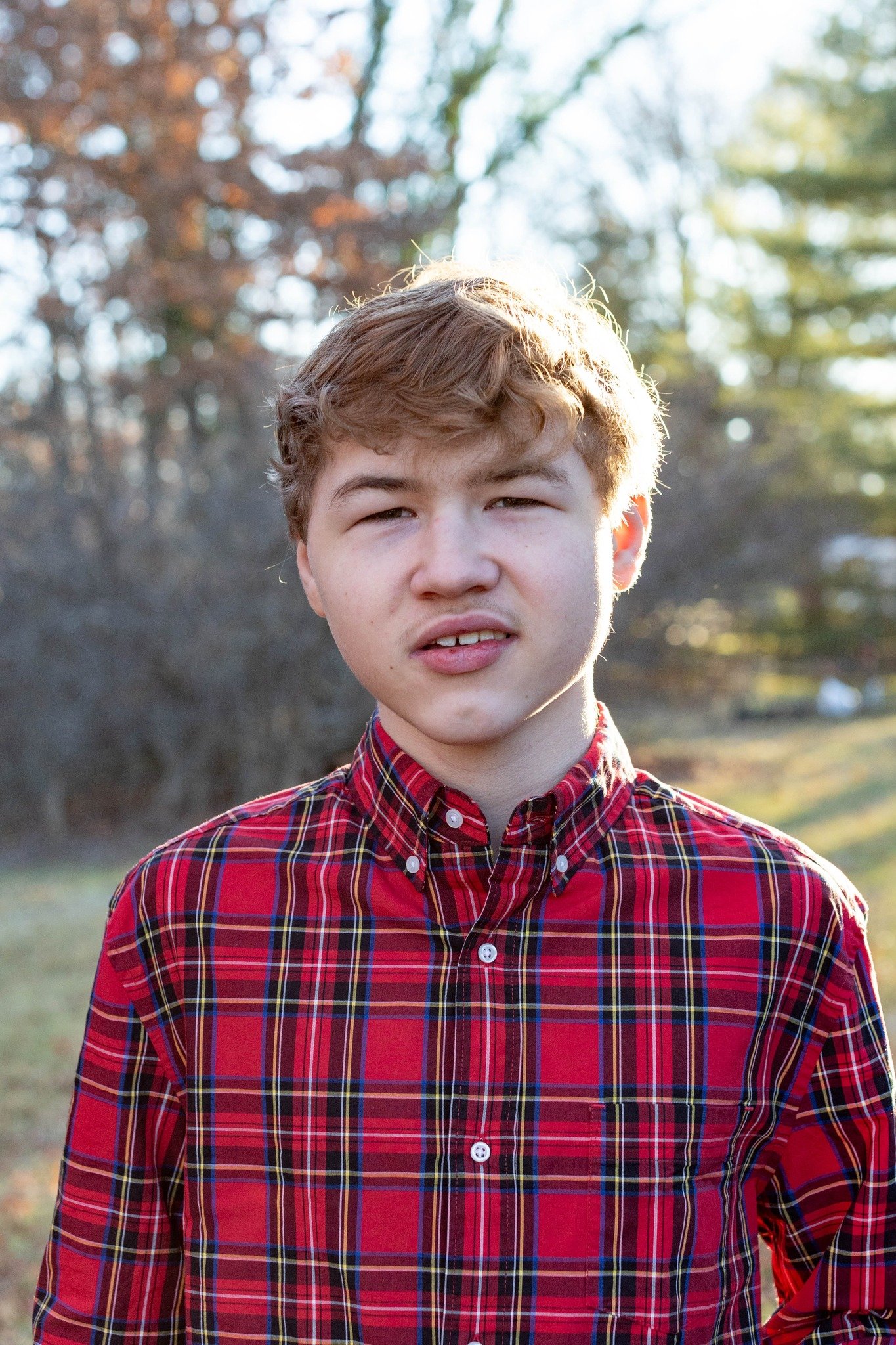
Charlie, the hero of our story, the air that I breathe.
On October 7, 2026, after 16 years of looking, I learned that my son Charlie has a variant in SLC35A2, a gene associated with SLC35A2-congenital disorder of glycosylation (SLC35A2-CDG). Charlie developed infantile spasms before his first birthday. Since then he has had ongoing seizures, severe intellectual disability, two brain surgeries, and many rounds of genetic testing that found nothing.
My work is in data science and biomedical informatics. Part of that work is figuring out how to document, in meticulous detail, people with mysterious diseases such as amyotrophic lateral sclerosis (ALS), where the cause is often unknown, so I know as well as anyone how complicated and challenging it is. I also have the lived experience of searching for my own child's diagnosis. These are my first impressions, one day after getting the answer, of what I learned.
The features that were never written down
The first thing I learned is that the features with no obvious connection to the disease were as important as the seizures, and in Charlie's case probably more important. In epilepsy we tend to focus on seizure types, seizure frequency, age of onset, developmental concerns, then run those data alongside the genetic results and look for a match. Over 16 years of studies, those were the things I was asked about, and they are important.
Charlie is a handsome, beautiful child, and I would not describe him as having facial differences. He does have thick eyebrows, a broad nasal bridge, eyes with a slightly unusual shape, and inverted nipples. I began telling anyone who would listen about the nipples before he turned one, soon after the spasms started, and the usual reply was to ask why I was worried about his nipples. Experts shrugged, called it a quirk, and did not write it down, and I now believe that is where the search kept going wrong.
After the result came in, I read the SLC35A2-CDG page on the National Organization for Rare Disorders (NORD) website. Its overview lists thick eyebrows, a broad nasal bridge, and inverted nipples among the dysmorphic features, next to early epileptic encephalopathy, severe developmental delay, and brain abnormalities on magnetic resonance imaging (MRI). Those are the features I had been pointing to since Charlie was a baby. Across two brain surgeries and countless studies, nobody had asked me about them (although I would make sure they were noted down anyway), and now they read as an obvious clue.
Those features help because of how a variant of uncertain significance is resolved. The team compares the child's phenotype with published cases of other people who have variants in the same gene, and asks how likely the resemblance would be by chance. Epilepsy and intellectual disability appear in a great many genetic conditions, so on their own they do little to separate one gene from another. If inverted nipples are also reported in children with variants in that gene, then a child with epilepsy, intellectual disability, and inverted nipples looks much more like a match, and the team can be more confident in the diagnosis.
That comparison is only possible when somebody has recorded the feature. For us, it took a clinician sitting down with Charlie and writing down everything, in full detail, before the pieces could be compared.
How the answer was found in brain tissue
The variant was found in brain tissue removed during one of Charlie's epilepsy surgeries, which is a longer story that I will share separately. For years I understood that the tissue could not be tested, because of the way the sample had been fixed and stored after surgery and the methods available the last time we looked into it.
At a conference, I sat down to lunch and happened to start talking with a doctor I had never met. I was ready for that conversation because I give everyone the same spiel about Charlie, and I had it prepared. When I mentioned how unfortunate it was that the tissue could not be tested, he told me he thought there might be a workaround. We talked it through, I found someone to run the testing, and I arranged for the samples to be sent. Having my story ready is what allowed me to meet the moment and seize the opportunity, and without that conversation we would still not know Charlie's cause.
What I would tell another family
Trust your gut. My gut told me from the beginning that when we figured out what was wrong with Charlie, it would have something to do with his inverted nipples. Plenty of people told me I was focusing on the wrong things, and most of those who found it interesting did not take it seriously. I was not a panicking, grieving mother who needed to be humored. I could see that he had a constellation of features, and I had never seen another child who looked like him. To be clear, after speaking to the genetic counselor, it seems that these little quirks were not the main basis for the diagnosis - they relied heavily on more traditional neurology-related features. However, it is clear that if inverted nipples, bushy eyebrows, and the rest are so common, that flagging these features in kids who are still undiagnosed would be a great help in the analysis.
Find a clinical champion. We have an incredible neurologist who did what it took. Becoming a self-taught genetic counselor was not on anyone's bingo card when their child was born, so we may not describe what we see in the expected vocabulary. A champion is someone who is willing to work out what you are trying to say, and who appreciates your persistence about the things your gut tells you.
Look for team science. Charlie's neurologist was open-minded about working with a different neurologist on this, and I think it was an incredible model of team clinical care and of team science. We would not have an answer without it, because the doctors could have disagreed on the approach and set my wishes aside, and then we would never have known.
Talk to the younger clinicians and scientists. They know the newer methods and they have good ideas. Our answer came from a young doctor with a new idea, and I would have missed it if I had only listened to the people with the most seniority.
Be the squeaky wheel. Call everyone and talk to everyone, without being intimidated and without worrying about sounding stupid. We would not have an answer if I had not struck up a conversation with a stranger over lunch.
Have your story ready, unusual features included. You may meet the right person with no warning, so prepare a short version you can say on the spot. Mine was that my son had late-onset infantile spasms, that he has a diffuse brain malformation unlike the classic patterns clinicians are used to seeing, and that he has a broad nose, bushy eyebrows, a slightly unusual facial appearance, and inverted nipples.
Learn the basics of genetics, and help your community learn them. In the 24 hours after I got Charlie's result, I spoke with parents, people who work in this field, and people who run patient advocacy groups who did not know that a variant can be somatic instead of germline, or that mosaicism means a variant can be present in some of a person's cells and tissues and absent from others. Our answer was in brain tissue after years of other testing, which is why those concepts are on my mind. It is hard to advocate for something you do not understand, so I see a real opportunity to educate ourselves and our communities about genetics, and about how detailed phenotyping is used to interpret a genetic result.
Open science and data standards for our disease communities
Our disease communities need to embrace open science, data standards, and ontologies. The people behind efforts such as the Mondo Disease Ontology and the Global Alliance for Genomics and Health (GA4GH) know how to document a phenotype so that it can be compared with other cases, how to share data, and how to write the software that does the comparing. Many families and advocacy groups have never heard of informatics, so this work gets little of their attention, yet these are people who want to help us and have the skills to do it. What they taught me is what allowed me to push Charlie's case forward and be ready when the opportunity came.
Our own answer shows the connection: the NORD page where I recognized Charlie states that its content was gathered in partnership with the Mondo Disease Ontology. The Human Phenotype Ontology (HPO) has a term for inverted nipples, HP:0003186, so a clinician who notices the feature has a standard, computable way to record it.
I think one of the best things a community can do now is get its data ready for artificial intelligence (AI), so that classifying each person correctly gets easier and mistakes get harder to make. The standards I rely on for that are HPO, Mondo, GA4GH Phenopackets, and the Observational Medical Outcomes Partnership (OMOP) Common Data Model, and I am now learning the Linked Data Modeling Language (LinkML). Links to each are at the end of this post.
Registries: HPO-based questions and links to biological samples
If you are building a registry, I recommend including, at a minimum, a general health survey whose questions are attached to HPO terms. Many large registries use the GenomeConnect survey or a similar HPO-based survey. GenomeConnect is the patient registry of the Clinical Genome Resource (ClinGen), and Savatt and colleagues describe it in a 2018 paper in Human Mutation, which reports that other registries and research groups have adopted all or parts of the survey. The supplement to that paper shows the question wording, the HPO mapping for each question, and the branching logic.
The survey works as a review of systems. It asks about each general body system, and a participant sees the follow-up questions for a system only after reporting an issue there. That design lowers participant burden while still covering the broad areas where a person might be affected, and I understand that several popular registry platforms, including Across Healthcare's Matrix platform uses the same approach.
This coverage is especially important in studies where researchers receive the data downstream and cannot go back to participants with questions. Your doctor is not behind the scenes with the researchers who use the data, so they have only what was reported. The more standardized, structured, and comprehensive that report is, the better the chance that someone can find the pattern, because a review of systems asked of every participant gives a feature outside the main disease area a place to be recorded.
Patient advocacy groups that create their own registries also need to know where their participants' biological samples and biological data are held. Our answer came from tissue stored after a surgery years earlier, and it was only useful because someone could find it and test it. I would encourage groups to collect that information and to make sure the phenotyping from a natural history study can be paired with the biological data, since each is much harder to interpret without the other.
What a diagnosis changes
Does knowing Charlie's variant change anything? For treatment, I do not know yet. From what I have read so far, precision medicine programs for this gene are in the works and still early. There may be a dietary supplement he can try, and there may be a clinical trial. A trial designed for Charlie's condition is what I have wanted for 16 years, in place of trying another drug because it sometimes works for other children. I have also wanted a way to anticipate which other organ systems might be affected, and now we have a chance at both. Charlie is 16, he has been through a great deal, and a lot of damage has been done, so I cannot say how much will change for him medically.
Where I am confident a diagnosis will help is in getting services. Until now, Charlie's history read as infantile spasms, which he no longer has because he is no longer an infant, followed by severe seizures and an intellectual and developmental disability (IDD) with no named cause. I had no literature to point to that shows how severe and how lasting his condition is. Other families may be surprised by how much proof is demanded, even for a child who cannot speak and has had multiple epilepsy surgeries. I am paying thousands of dollars out of pocket for a private neuropsychological evaluation, because some of the people willing to assess him for free have raised possibilities as unrealistic as driving a car. My impression is that programs sometimes try to fit a child into a vocational track they already offer, and acknowledging how impaired he is would rule that track out.
A named rare disease, with published papers describing children who are as severely affected as he is, gives me something to show a reviewer. It is a constant battle even with that kind of evidence, and it has been far worse without it.
Over the years I have often been asked what a diagnosis would really change, and whether it might be better not to know. My answer is to let the family decide that. If Charlie qualifies for an aide because of this diagnosis, I can go to my other children's soccer games, Charlie can come along with hands-on support and have a good time, and I can sit with one of his siblings without worrying about catching the signs of a seizure. That changes life for everyone in our family, and it is a benefit we rarely talk about.
These diseases can leave children needing support 24 hours a day, and families often feel that nothing they do is enough to prove their level of need. The experts who understand how severe these conditions are do not review our applications at school or in the community. The people who do review them need to be educated, and it is close to impossible to educate someone about a condition that has no name.
Easier access to genetic testing
We need to make genetic testing easier to get. The epilepsy community has seen a boom in genetic findings because testing is now far more routine for people with epilepsy, and it was not always that way. Before Charlie's first brain surgery, I remember fighting the insurance company hard, together with his genetic counselor and his neurologist, for a basic panel. We have come a long way since then, in large part because of advocacy, including work I was involved with, and I am proud of that. I see no reason other disease areas cannot do the same.
The families who are still searching
My first instinct after learning Charlie's variant was to give all of my time and energy to the SLC35A2 community. I will get involved with that community, and I also think we have to remember the families who are left behind without an answer. That is the ethical thing to do, and it is also sound science. For years, the community around Charlie's gene held conferences and did its work without knowing we existed, which means it went without Charlie as a member and without my help or perspective. Other people who belong in a gene community may still be out in the unknown, as we were.
We also have more in common than we have differences. Seizures and intellectual disability are shared across many of our conditions, and each condition then has its own distinguishing features. Helping families who are still undiagnosed and working on what we share is how a rising tide lifts all boats.
Working across diseases
Those of us who have been through this should reach across disease areas, to the extent we have the energy. Many people with ALS are in the position we were in, with no known cause for their disease. If the epilepsy community has worked out strategies that help, we should bring them to ALS. ALS is where I work and it is my passion, and I need more help there.
I often think about the ALS doctors and the epilepsy doctors who sit next to each other on the same floor of the same building. They may share a data engineer and a biomedical informatics department, yet they run separate studies with them, apply for separate grants, and sometimes compete for the same ones. That cannot be the most efficient arrangement. I would like us to think in terms of neurology informatics, in place of an epilepsy informatics project and an ALS informatics project. That is how I work: I help anyone who comes to me, whatever their disease, and we all learn from one another that way.
I am sure I will have more thoughts as time goes on. One day in, what I see most clearly is how much opportunity we have to change the world. This is Charlie’s legacy. Sixteen years is a very, very long time.
Links
SLC35A2-congenital disorder of glycosylation, National Organization for Rare Disorders (NORD): the description where I recognized Charlie's features
Mondo Disease Ontology: harmonized disease definitions
Global Alliance for Genomics and Health (GA4GH): standards for sharing genomic and health data
GA4GH Phenopacket Schema: a standard format for one person's phenotype and genetic findings
Human Phenotype Ontology (HPO): a standardized vocabulary of phenotypic features
ClinGen's GenomeConnect registry enables patient-centered data sharing, Savatt et al., Human Mutation, 2018: the supplement shows the general health survey with its HPO mappings and branching logic (free full text)
LinkML: an open framework for modeling and sharing data
OMOP Common Data Model, from Observational Health Data Sciences and Informatics (OHDSI): an open community standard for observational health data
I Already Know a Lot About You
On advocates, allies, and the different ways of showing up in a patient community
Much of my week is spent logging into meetings with people I have never met. Some of those meetings are in the rare epilepsy community, where I am the mother of Charlie, who has Lennox-Gastaut syndrome, a rare and devastating form of epilepsy. Others are in the amyotrophic lateral sclerosis (ALS) community, where I work as a researcher. I also volunteer in other disease domains, both rare and not rare. Each time a new group of volunteers appears on my screen, whether it is an advisory board, a steering committee, or a brand new working group, I already know a lot about the people in it before anyone has said a word.
I know that each of them saw an injustice and wanted to correct it. I know that each of them has a skill that could help, often one that is expensive and that a small organization might not otherwise be able to come by. I know that they understand this about themselves and decided to give it away.
I often say that through having Charlie I have seen all the bad and all the good there is in the world. Without him I would not have seen all of the bad, but I definitely would not have seen all of the good. A large share of that good has come from people whose way of helping is easy to miss, and this post is about them.
Help that is easy to see
Over the years people have shown up for my family in ways anyone would recognize as generosity. They have sent meals, arranged respite care so that I could have a night off, delivered equipment, sat at a hospital bedside, raised money, and checked in on my husband and kids while I was away on a business trip. I have benefited from all of these, I am grateful for every one, and nothing in this post is meant to take anything away from them.
This kind of help is visible, since you can see the meal on the porch and the total on the fundraising page, and so the thank-you comes naturally.
Help that looks like a job
Because I work in research, I know what a research or clinical job requires. I know what a person in one of those jobs has to do to get paid and to get promoted, which means I can also tell when someone is doing far more than that.
I think of the person from one of Charlie's former teaching teams who agreed to work with a neuropsychologist I had hired, and who took great care to answer a long set of questions that are hard to answer for a child like Charlie. That was time in the day that could have gone to paid work. I think of the neurologists I see at local epilepsy events and patient conferences, and the scientists who could speak on the biggest stages in their field and still give up a weekend to travel to a small advocacy meeting. I think of the attorneys who sit on nonprofit boards because a friend of a friend has a child with the disease. None of them had to be there, and staying home would probably not have hurt their careers.
When I log into a meeting full of professionals who are there as volunteers, I see people pulling up to the house with a chest full of treasure. Their expertise is the most valuable thing they have to give, which is why they were asked, and they are giving it. For many of them, purely in terms of financial value, it is a far bigger gift than a gift card for dinner delivery.
I see Charlie's neurologist this way: he could have chosen an easier path in medicine, and instead he spends his days caring for children with severe epilepsy that has no cure yet, and talking with parents who are beside themselves with grief and worry. He is a person, and I know it affects him when Charlie is not doing well. All of those extra calls and emails, those community events I see him attend - that is a meal delivered to our family, and his version of sitting with the kids so that I can go out for a coffee.
The same is true of the scientists I work with, who are some of the smartest people I have ever met. They are the smartest people I have ever even heard about. Far smarter than I will ever be. They could be doing almost anything, for more money and with far less frustration and sadness, and they chose to work against the epilepsy and ALS clocks.
When I meet an early career scientist who is interested in epilepsy or neurodegenerative disease, I already know a lot about that person too.
The question of career benefit
I have heard the criticism that professionals come to patient events because it is good for their careers (funding, publications), and sometimes that is true. Affiliation with a patient group can lead to funding and opportunity, especially early in a career. I encourage advocacy groups to say so plainly when they recruit early career advisors, because someone with only a few years of clinical research experience can offer a group a great deal and deserves a line on a curriculum vitae (CV) in return.
I would only ask that we slow down and think about what the criticism implies. A researcher who wants a grant to study a rare disease has chosen a field that is rarely a path to wealth for an academic. There is no grant that they will ever win with a small patient group that will replace the riches they could have made had they taken a more lucrative career path in the first place. Some benefit to the helper does not cancel the gift, and most of what I watch these volunteers do goes well beyond anything a promotion or funding committee will ever count.
How appreciation can go missing
In small ways and large ones, I have seen patient communities hold their professional allies at arm's length, usually without meaning to. The work can look like something the person is paid to do, so the thank-you that goes to other volunteers does not reach them. They are left off the more personal messages that go around the group, and they are not quite treated as part of the informal team. Their grief at a setback or a loss goes unacknowledged, as though a decline in someone they have cared for or studied for years would not touch them.
These volunteers are capable adults who can handle being overlooked, and most would never mention it. I am writing about it anyway because I think noticing it could be healing for all of us.
I want to be clear that I am not describing my own experience. The groups I work with treat me like a member of the family, and I chose them for that reason. Being treated that way is part of how I know what it looks like, and part of why I notice when someone else is on the outside.
Why we keep score
I understand where the distance comes from, and I do not think it comes from a bad place. Many of us came to advocacy because something deeply unfair happened to us or to someone we love. Once you have learned how unfair the world can be, through a disease like ALS or epilepsy, it is very hard to stop measuring what is fair. We keep track of who has done enough, who has real lived experience, and who is here for the right reasons, because we are trying to protect ourselves from being hurt again.
Sometimes that turns into frustration with the very researchers we support, because a treatment did not come in time for someone we love. Seeing a scientist enjoy a coffee or a day off can feel like proof that they do not understand the urgency. I know that feeling, and I think it is a normal human response to what many of us have lived through. I wish every epilepsy doctor and researcher could work around the clock, but because I am a scientist too, I know that they cannot.
What could change if we stopped keeping score
I cannot promise outcomes, but these are the changes I would expect, based on what I have seen in groups that already treat their professional volunteers as family:
Advisors stay longer and invite their colleagues, because people return to places where they feel they belong.
Early career researchers who feel welcomed are more likely to build their careers in our diseases, and our communities will need them for decades.
Families gain more people to celebrate with and to grieve with.
The energy that goes into deciding who belongs and who deserves credit can now be channeled into the work.
A community divided between people with lived experience and people who work on it transforms itself into one community with many ways of helping.
Small ways to show appreciation
None of this requires changing a partnership that is already working, and if your group already does these things, I hope you will read this list as recognition.
Thank professional volunteers in the same way and in the same places that you thank everyone else.
Include them in the personal messages: the birthday wishes, the hard news, the group photo.
When there is a loss or a setback, check on them too.
Tell them specifically what their expertise made possible.
Assume the best about why someone came.
Be glad when they rest.
A colleague once told me that work is my love language, and I think that is accurate. Teaching, advising, and helping people do the work they are trying to do is how I show love, especially for people who are trying to cure their own child's disease or make the most of their time after a diagnosis or a new disability. I believe the same is true of many of the professionals in our communities.
So if you are new to one of our groups, whether you arrived with a meal or with a skill, I already know a lot about you, and I am glad you are here.
A Solution in Search of a Problem: Designing AI Tools With the Rare Disease Community
The night I searched my son's diagnosis and read that he was going to die taught me what designing AI tools with the rare disease community, rather than for them, really asks of us.
Something has been weighing on me. I sit at the intersection of a few roles: I am a data scientist and an application developer, and I am the mother of a child with a rare, poorly understood, and currently incurable disease. From all of those seats, I have grown uneasy about how thoughtlessly some AI applications are being designed, including many that are advertised as “patient centered.”
I often warn my students not to be the scientist with a solution in search of a problem. We fall for a beautiful new tool and then look for somewhere to point it. That excitement is real, and I do not want to shame it, because I feel it too. Clinicians are excited in a different way: they have problems they genuinely need solved, and they can see what these tools might do for the patients in front of them. I share all of it. I wake up every day grateful for these tools. I believe that AI will finally help explain what happened to my son Charlie: why he had infantile spasms, why at sixteen he lives with multiple disabilities, why he still has frequent, life-threatening seizures, why I have never heard him speak a sentence.
Even so, I feel conflicted, because I work alongside teams who are just as excited as I am, and because I do not think even us “experts” always understand the tools we are building, and for whom we are building these tools. I worry that we are making mistakes that could hurt people. Here is the story of why I believe that.
The night I first heard "infantile spasms"
Sixteen years ago, my son Charlie began showing the signs of infantile spasms, though I did not know that at the time. It started at mealtimes. He would turn his head away from the spoon while I fed him. The pediatrician thought he was teething.
Then he became inconsolable. I will never forget standing at an open house for my older daughter's new preschool while Charlie screamed the entire time. Other parents looked over, not unkindly, but with the instinct parents have: something is wrong with that baby. We were comforting him, doing everything right, and still he screamed. I called the pediatrician again. Teething, he said, and he gently implied that I was an anxious mother. When I expressed concern about his development, his “too happy” affect, he said I was unreasonably comparing my son to his exceptionally bright older sister. Any parent knows the feeling I mean: you know when something is wrong with your child.
The strange movements came next. He would drop his head to one side. One evening we were sitting in the living room, not eating, and he did it again, the head drop, now coming in clusters, I now know to be an epileptic spasm. I had no vocabulary for any of this. I was a data analyst at a major academic institution, but I did not work in epilepsy, and I had never seen anything like it. This is a point I come back to often: most people are not experts in whatever rare disease finds them, and that has nothing to do with how good they are at using the internet. Vulnerability to poor information about a rare condition reaches everyone, including doctors, including PhD-level scientists. None of us knows much about these diseases until one arrives in our own home.
One thing led to another. I was sent from one hospital to another, and we arrived at the second one at night. They transferred us without telling me why, and by then I was frightened. They put Charlie and me in a small side room, really more of a closet with a pediatric stretcher in it. He could climb and crawl, and the bed was not safe for him, so I stood with one hand on him the whole time.
I had come straight from work. Earlier that day I had mentioned my nervous feeling to some physicians at my institution, not neurologists but knowledgeable enough, and they were the ones who told me the words: ask for an EEG. At first I misheard it as EMG. I did not know anything. Those of us who breastfeed and go back to work know that you cannot always wear at the office what you would wear at home to breastfeed a baby who is breastfeeding constantly, and Charlie was breastfeeding constantly, I now think to comfort himself. So there I was, in my work clothes, in a closet-sized room, trying to keep him calm and breastfeed him awkwardly in a silk blouse.
After a while, there was a knock, and three medical students or junior trainees came in to ask me questions. Those of us who work in healthcare know what that means. It means something is wrong, that this is the kind of case people want to see. They asked me about Charlie's history and his behaviors. I do not remember the questions; it is all a blur. When they finished, they left.
A resident occasionally looked in on us. He told me we would have to wait until morning, because no one could do an EEG overnight. I was trying to reach my then-husband at home on a BlackBerry. I asked the resident what he thought was going on, because I truly had no idea. In passing, he said they thought it was infantile spasms, that an EEG would confirm it, and that it would have to wait until morning. Then he walked out.
What the first search result told me
With one hand on Charlie, who would not settle, and screamed so much he was almost whispering, I typed "infantile spasms" into that BlackBerry. The first thing that came up was a peer-reviewed article by Dr. W. Donald Shields, "Infantile Spasms: Little Seizures, Big Consequences." I know now that it is a genuine and valuable contribution to the literature. In that moment, one line took my legs out from under me:
Infantile spasms is associated with a significant risk of mortality and morbidity.
It rested that claim on Riikonen's series, which had tracked 214 children for two to three and a half decades: close to a third of them died over the course of the follow-up, many before the age of three. It was the word mortality I could not get past, and the fact that a third of the children in that study had died, and I read every bit of it as being about my son.
My legs gave out. Charlie is going to die. I called my then-husband, who was home with our daughter. I called my parents, who started crying, and dropped everything to drive overnight from upstate New York to Baltimore, to say goodbye to Charlie and comfort me. The next twenty-four hours are a blur. They moved us to the neurology ward, where Charlie had an EEG the next morning. He had a stuffy nose, so everyone was in contact precautions and I could not see a single face. I called Charlie's godmother to come sit with me, because I had read that my son was going to die, and I could not read any further, and I was trying to keep him safe and comforted at the same time.
I remember thinking, I need to pull it together. I need to look good. I can't break down. I need to be smart. I need to hold it together so I can make good decisions for Charlie. I need to hold it together so I can make good decisions for Charlie. It’s important that these doctors see me as smart and rational. I need to keep it together for Charlie.
All day I had been asking about infantile spasms, and the senior doctors kept asking me where I had heard that phrase. I could tell they were unhappy that someone had said it to me, yet no one would give me information, because the EEG had to be read and discussed first. Finally, that evening, almost a full day after the resident's words, a team came in fully gowned, six or seven of them, or fewer, I could not tell, all faceless behind their precautions. They confirmed it: Charlie had infantile spasms. It felt like a gun going off next to my ear. I went down in a heap and said, over and over, moaning like an animal. “Charlie is going to die.”
One of them stepped closer and asked where I had heard that. I reached for the article, shaking, trying to find the website again. I did not need to. He knew exactly what I meant, because that is what came up when he searched "infantile spasms," even through a trusted resource like PubMed, which is what I had used, because I was an epidemiologist, and I know exactly where to find the “credible” information.
Why "credible sources" were not enough
Here is what the doctors could not tell me at the time, and what almost no one could: we knew very little about the causes, the triggers, the mechanisms, or what predicted whether one child would do better than another. What the framing of that era did say was that if no cause could be found, a child was expected to do better, not worse. They could not find a cause in Charlie, and nothing I described seemed to fit a known one, so they told me he would probably have a better course than I feared, and probably would not die, at least not right away.
It would later turn out that Charlie had a malformation in his brain that no one can explain, which they believe may have a genetic root that has still not been identified. Sixteen years on, after watching the number of genes we can test for grow from a handful to hundreds, no one can yet tell me what caused his spasms. Last month I finally arranged to send old tissue from one of his two brain surgeries to a scientist I had tracked down at a conference, one I attended and paid for out of my own pocket, in the hope of finally learning what happened to him. If you think families like mine turn to the internet for answers, you have no idea how far past the internet we will go to understand our child's condition.
So do not build a tool that claims confidence it has not earned. I know myself well enough to know that if this were happening to me now, and a tool were branded as smarter than whatever I could find on my own, I would take it seriously. If that tool brought up the same article, it would be worse for me than the open web was, not better, because the branding would tell me to trust it. That article had been set aside by a doctor as out of context and out of date, and yet it is exactly the kind of source that an AI chat is likely to bring up.
We tell ourselves that if we feed these systems trusted, credible sources, the output will be sound. For rare diseases, that assumption breaks. These conditions are notoriously underfunded and poorly described. Patient advocacy groups largely exist because the information their families found online was inaccurate, incomplete, and disorganized, and they wanted to address that. If we pull only from so-called credible sources, however we define that, we are frequently pulling the same thin material that families and clinicians already read. The doctors gave me information that we would not consider correct today. It may have been the best reading of the literature then, yet we understand it very differently now.
Make that make sense: we are rushing to put AI inside our applications while doing nothing to improve the quality of the information underneath it. You cannot train a model on data that do not exist. This is why co-production with the patient advocacy community is not optional, and it is the heart of the ethical concern about the confidence these tools imply. There is no fiercer champion of AI than a parent whose child has an undiagnosed or poorly understood disease. We embrace these tools, and our embrace carries an expectation that the tool knows more than we do. If the same model sits underneath a chatbot that a tech leader says was built specially for us, and it returns the same article a family could have found alone, it has given them nothing new. It has only made the old answer feel more certain, wrapped in a confident tone. What have we done?
What a better tool could have done
Picture a well-built epilepsy resource, made with the community, with a chat feature. I type in the only words I have, the ones the resident gave me: infantile spasms. What could it have done differently?
It could have started by telling me that this is complex and multifactorial, that I would find many frightening things online, and that because the condition is so varied, I could not take a statistic from one group and apply it to my child. I cannot take numbers from children with tuberous sclerosis, a common cause, and assume they describe a child with Gould Syndrome, or a child with an SCN2A variant. A group number does not describe an individual, and a number for one cause does not transfer to another. Just knowing that would have steadied me.
Then it could have told me the single most useful thing: have this conversation with your clinician, and here are the words to say. That one sentence, first, would have changed everything about that night. It could also give the clinician a fact sheet prepared by the scientific advisory board of a patient advocacy group, so no one loses precious moments searching for one.
The other thing it could have given me right away was a link to the online community that other parents had built, which is where I found nearly all of my comfort and information in those early days. On my own, that resource took me weeks to find.
Where would language like that come from? From the community. We would come together and agree on how to talk with a parent who has just heard the words infantile spasms, because we have all lived some version of the night I just described. My story is not singular. A group of people who have searched the internet in terror for their own child's condition would know exactly what to write, and we would test it, and we would all be able to stand behind it.
There is one more thing I came to understand that no chatbot could have told me, though the community could. Over the years I have met literally thousands of families affected by infantile spasms. Among them are many whose children largely recovered, including many who underwent hemispherectomy, the surgery that removes half of the brain, and who have gone on to college, to careers, to full lives, getting married…even though those stories rarely make the headlines but are the stories we all cling to in those early years. If you built a tool with the community, we would make sure you found that; and you would not find that on PubMed, StatPearls, or UpToDate.
There is one more piece I want to add. The article had described two risks, death and serious developmental disability, but in my panic I had read only the part about death. What the team offered me, once they finally spoke with me, was their reading of Charlie in particular. Given what they did and did not know about his underlying cause, they did not expect those mortality figures to describe him, and they thought the more likely reality for him was the developmental disability rather than death. My heart soared. Charlie will be severely disabled, but he is probably going to live. In a way that may sound strange to someone outside this, I was flooded with relief, because I would love Charlie through anything. It never once crossed my mind to grieve his intellectual disability for its own sake. As long as I had him, and he was not suffering, we were going to be all right. A candid tool, built and vetted by the community, could have helped me hold both truths at once, the stark statistic and the reasons it might not be my son's story, hours earlier than a gowned team with no faces finally did.
Questioning the treatment
Over the years, I came to question the treatments Charlie was and was not offered. Infantile spasms has a narrow set of first-line therapies, treatment should begin quickly, and surgery should be considered for the right candidates. Many children never receive the right regimen, for reasons that include gaps in provider education, fear of the side effects, and the cost of the medication. Imagine if, during the years I suspected he was not being offered the right options, the community had already assembled the information that an AI drew from, so it could give me that picture in a clear, responsible, usable way. That would have been a gift.
I am not saying we should avoid AI. I am saying that when the output of an AI tool merely reflects the status quo back at us, that is not good enough, and it is not responsible. That is us enjoying our tools and congratulating ourselves on a clever product.
The community is already building
In the past few years, I have watched an explosion of innovation coming straight from patient advocacy groups in how they use AI. At the same time, I have seen an assumption in parts of the research and clinical development world that patients do not know how to use these tools themselves, that handing them essentially the same capabilities they could get anywhere and calling it new is somehow enough. “Look, here is this thing called ChatGPT, but this one has a purple ribbon, so you know it's for epilepsy.” No. Not good enough. Families already know how to use these tools, maybe better than we do. I have watched groups build entire knowledge graphs, coding their way through it by trial and instinct. If your child has one of these diseases, nothing will stop you. You will learn, and you will become an expert.
So if you are wondering why a community rejects your tool, or there is no traffic coming to your site despite announcing it at conferences, posters, abstracts, and webinars, consider that they are not naive, and that they could probably build something better themselves.
If you do not involve the patient community from day one, the only conclusion I can draw is that you do not care about the people who will use your product. Try to imagine any other business approaching product development this way. Imagine designing a car without asking a single driver what features that they want that car to have. Of course you would ask them, because you want to sell cars. But if you do not ask the people who would use your AI product what they think, or whether it would help them, or you push back on their concerns about your “trusted sources,” I can only conclude that you do not care whether they use it or like it. That tells me a great deal about you in general, not just about this product.
If you want to do this well, if you want to use these tools the way our talents are meant to be used, here is what I would ask.
Design considerations for co-produced tools
Co-produce from the first day. Build with patient advocacy groups and participants, not for an imagined version of them. When a group or a single participant tells you something concerns them, treat it as a finding, not a nice-to-have.
Improve the information underneath, not only the interface. A chatbot running on the same model a family could use for free, drawing on the same thin literature, gives them nothing new; it only wraps the old answer in more authority. The value has to come from better, community-vetted information at the foundation.
Represent the state of the literature truthfully, including how thin it is. Say clearly when little is known, and do not imply a certainty the field does not have.
Do not move statistics across causes. A number from tuberous sclerosis does not describe a child with SCN2A or Gould Syndrome, and a group number does not describe any one child. Build that warning in.
Point people toward their clinician, and give them the words for that conversation. Often the most useful first response is help starting the right discussion.
Test with a real range of people before release. Include people who are frightened, exhausted, and new to the vocabulary, which describes most of us at the moment of diagnosis.
Make it easy to share. Let a family show a clinician the exact output they saw, word for word, so the tool supports the conversation instead of standing in for it.
Date what you show, and cite where it came from. Let a reader see when something was true and check it themselves.
Disclose what was made by AI and what was written by a human. I learned the importance of this when I vibe coded a knowledge graph with Claude for my internal team; it generated very smart-sounding summaries that were often wrong, misleading, or out of date. I only knew because I am a domain expert, but if I had not read it carefully, even I would have missed it.
I have seen at least one early effort that takes this seriously. The Dravet Syndrome Foundation is developing an AI-powered Dravet Syndrome ontology out of exactly the kind of co-production model I have been describing. I had the great privilege of testing it, and I am struck by the care and responsibility going into the work.
What we are called to do
I work across several diseases through my teaching and my advising, but especially ALS, and I know firsthand how difficult it is to do this work well. Every day I wake up grateful for these tools, and I am personally doing things I could not have done without them. But when we pour our effort into the engineering and the fun of what else we can make these systems do, without ever asking who is on the other end reading the result, and then we call ourselves patient centered, that is not it, folks. That is not what our talents are for. That is not why we are here.
This goes out to all the well-meaning people who simply never thought of it this way. Let us do it together, as a community. We are pioneers. Last week I was still coordinating the testing of a piece of my son's brain, still trying, sixteen years later, to learn what happened to him. I would have given anything, that night in the closet-sized room, for a tool that told me the truth gently: that this is complicated, that the frightening number I had just read might have nothing to do with my child, and that the next thing to do was talk to his doctor, and here is how to have that conversation. We can build that. We owe it to the people who will search these words late at night, with one hand on a child who will not stop screaming, and one hand on their phone.
Source
W. Donald Shields, MD. Infantile Spasms: Little Seizures, Big Consequences.Epilepsy Currents. 2006;6(3):63–69.
Missing Not at Random: Why EEG Data Are So Precious
EEGs can be very difficult to obtain
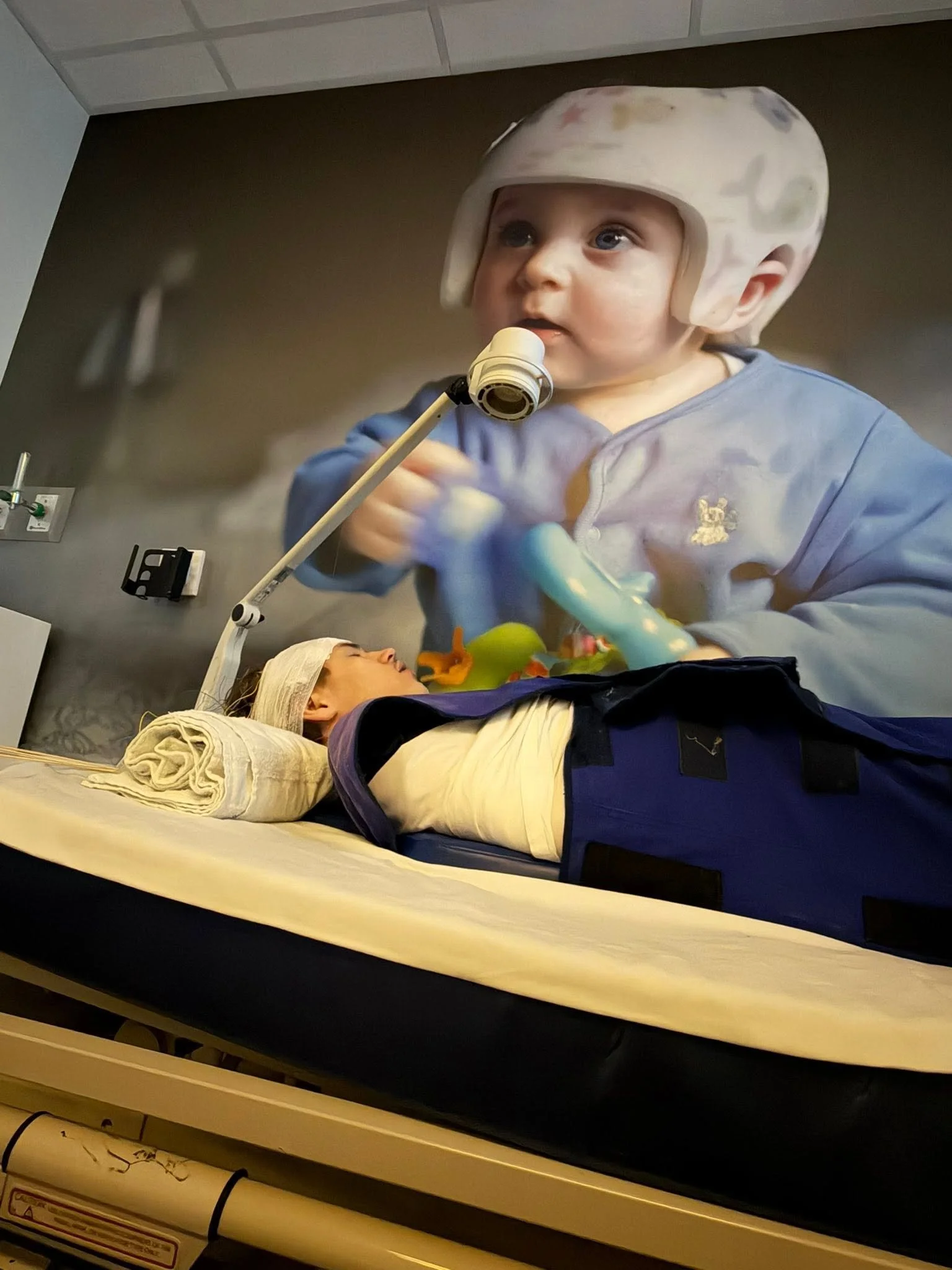
Charlie has an inpatient EEG next week; “three to five days,” starting Wednesday. I put out the "Bat Signal" to the other epilepsy families on Facebook.
Epilepsy families:
Charlie is doing an inpatient EEG next week. He is like a toddler in a grown man's body. For the 20 minute EEG they had to put him in the wrap thing the whole time because the minute they let one arm out those leads were history.
What is your best advice for big kids who cannot be easily distracted? I tried to explain the situation to the EEG people. Bless them, they are sending in Child Life but so far the only options they recommend are toys and "distractions" but that's not how Charlie rolls. He doesn't follow a TV show. Like...based on that conversation they don't seem to get it which is weird since I KNOW he is not the only kid like this. He will rip those leads off of his head the very second he has an option and I can't physically hold his hands for three days. I messaged the team to tell them to eat their Wheaties and don't overschedule that day...I am planning on sitting right in the bed with him the whole time and am wearing my stretchy pants because it will be a marathon.
I guess we will try to do our best but if anyone wants to weigh in for a blog post on best practices from experienced parents it could help others, let me know!
What the experienced parents said
I am de-identifying everyone here, but I want you to hear the collective voice, because it is remarkably consistent:
My son is exactly like yours. We had to leave a sleep study in the middle of the night. The leads never stood a chance and he wasn't sleeping anyway. He's bigger and stronger now and I can't just hold him down.
We had a home study scheduled. The tech spent three hours trying to get him hooked up and he took off every single lead. We ended up inpatient. And sedated.
I can't get her to sit still either. She'll rip stuff off in the blink of an eye. We've had to sedate her to get through any lengthy test like this.
I'm dreading the next time they suggest an EEG. It's just not possible anymore. Even if you manage to get the leads on, he'll just pull them off.
He dislikes people being in his face or trying to touch his head, unless you're massaging his scalp, which he's fine with.
And more than one person said the same thing about Child Life, with real affection: they mean so well, and I stress out anyway, because he just throws the toy across the room.
Several people had no advice at all. They just said: I've been through it, it isn't easy, I cried, you are not alone. Which, honestly, helped as much as anything.
But there were also a lot of specific, hard won, genuinely clever suggestions, and I do not want a single one of them to get lost. So here is the full list:
For engagement and distraction
- FaceTime with people he loves and recognizes. This came up more than once, and from families whose kids do not track a TV show.
- Game shows on a loop. Family Feud and Wheel of Fortune were both named.
- Music. A basic MP3 player, a Yoto or similar, and a tip I had not thought of: you can convert audio from YouTube for the non-traditional things your kid loves that are not on any streaming service. A keyboard or other instruments if the unit allows it.
- Plastic eggs with treats inside, hidden around the room for an egg hunt.
- Favorite items placed within arm's reach of the bed so he has to find them.
- Cards, blocks, drawing, if those are things your kid engages with, even in short bursts.
- Food. Do not underestimate food.
- Visits from family and friends on a rotation, if the unit permits it.
For the leads themselves
- A felt backpack, sewn by a friend, to hold the lead pack. This is one of those solutions that only ever comes from a parent.
- Elbow immobilizers, the elbow no-nos. Two different families named these independently. One had used them to keep a chest tube in place. They prevent the arm from bending up to the head without full restraint.
- Ask whether he can get up and walk around the room while connected. Some setups allow more mobility than you would assume.
- Ask about cap EEGs, if precision requirements allow it.
For staffing and timing
- Bring backup. One mom brings her own mother to every overnight EEG so there are two adults in the room. She described it as the single thing that makes it survivable.
- Ask the hospital for a sitter in the room during all awake hours, for extra hands. One family has this arranged now as standard, and it changed everything for them.
- Time the placement strategically. One family got through hookup after an ER trip when their daughter was already loaded on Ativan. Not a plan you can schedule, but if you are already in a situation, use it.
- Sedation, when nothing else works. Several families have gone this route for lengthy studies.
And one from the outside-the-box file
- Think about your kid's idiosyncratic triggers. After several days inpatient with no seizures captured, one mom mentioned to staff, half joking, that sugar was her daughter's trigger and a sucrose bag might do the job. They tried it. It worked.
I am not just Charlie's mom. I am the Data Mom.
I spend my professional life working with observational health data. Registries, electronic health record (EHR) data, common data models, real world evidence. And when I read that Facebook thread, I did not just see a hard week coming. I saw a structural gap in the epilepsy evidence base, described in the plainest possible language by the people living inside it.
Plenty of people with epilepsy, including plenty with significant disabilities, get through EEGs just fine. Some kids nap right through placement. Some adults have done it so many times it is routine. This is not a universal problem.
But it is a very common one, and the people who cannot tolerate the study are disproportionately the people with the most complex, most severe, most treatment resistant epilepsy. This is the exact group we most need to understand.
Here is the thing about EEG data. It is one of the richest, most objective signals we have. It is how seizure types get characterized. It is how surgical candidacy gets decided. It is increasingly the substrate for machine learning work, including seizure detection, seizure forecasting, EEG based biomarkers, and automated phenotyping. Enormous methodological energy is pointed at EEG right now, and rightly so.
But many of the people in those very data sets could barely tolerate the recording. That is not a small caveat. That is a selection mechanism operating on exactly the axis we most need to study. How many never made it into the data set at all?
Where the missingness comes from
Some never get the study at all. A neurologist who knows the family looks at the situation, weighs the odds, and does not order it. That decision leaves almost no trace in the data. There is no code for we didn't try because we knew how it would go.
Some start it and abort it. Three hours of attempted placement, a middle of the night departure, an incomplete recording. In most systems that becomes a cancelled encounter, a short unusable file, or nothing.
Some get it under sedation. Which is often the right clinical call and I will never second guess a family who made it. But sedated EEG is not necessarily the same measurement. If you are training a model or defining a phenotype and you do not know sedation status, you have quietly mixed two different things together.
Some get through it on the strength of a parent sitting in the bed for seventy two hours.
For these reasons, the EEG data we have are not a random sample of epilepsy. They are a sample weighted toward people who can sit still, and toward families with the reserves to make it happen. That is a bias with both a clinical and a social gradient.
This is exactly why we built REST-LGS
I have lived it from the research side too. I am one of the authors on the Refractory Epilepsy Screening Tool for Lennox-Gastaut Syndrome, the REST-LGS. If you have not run into it, the short version is that LGS is an epileptic encephalopathy that starts in childhood and is classically defined by a triad: multiple seizure types with childhood onset, intellectual disability, and a characteristic EEG pattern, specifically slow spike and wave discharges under 2.5 Hz.
Notice the third item. The diagnosis depends on an EEG finding.
Now think about who has LGS. Adults with drug resistant epilepsy and intellectual and developmental disabilities. Many of them living in group homes or residential settings. Many of them exactly like Charlie. The syndrome also evolves, so the EEG signature can change or evolve, which means every EEG is key to understanding the person's history. Childhood records frequently do not survive the transition from pediatric to adult care; and it is extremely challenging to obtain EEGs on adults like Charlie.
So we built a screening tool that does not depend on any single finding. Eight criteria, four major and four minor, developed through a modified Delphi process with epileptologists, epilepsy nurses, residents, and scientists. It was designed to be usable by non specialists, including primary care providers, and to be populated from whatever records actually exist.
Then we tested it in the real world, in a retrospective chart review of 100 adults with drug resistant epilepsy and intellectual and developmental disabilities. And the missingness was stunning.
Slow spike and wave history on EEG: unavailable for 46 percent.
Age at seizure onset: unavailable for 42 percent.
Both of those are major criteria. Other EEG abnormalities, a minor criterion, was unavailable for 49 percent.
Nearly half the sample had no usable answer for the single most syndrome specific feature in the definition.
We had to add a weighted scoring system, giving major criteria three points and minor criteria one, precisely so the tool would still function when the EEG data were missing.
Of the 74 adults in that review with no prior LGS diagnosis, 42, which is 57 percent, screened as possible or likely LGS. Those are people who had been living for years, sometimes decades, with drug resistant epilepsy and no diagnosis other than "seizures" or "epilepsy." A syndrome diagnosis is not academic. It changes which medications are indicated and covered by insurance, it can reduce polypharmacy, it connects families to a community, and in a population with elevated risk of sudden unexpected death in epilepsy (SUDEP) it changes how seriously the seizure burden gets treated.
So when I say EEG data are precious, I am telling you that we had to design a diagnostic instrument around its absence.
Making EEGs easier to obtain and share
If you are in a position to improve any of this, here is what I would like you to do.
Make acquisition easier. Some of this is technology. Dry electrode systems, cap based setups, ambulatory and home recording, subscalp and implanted devices, wearables that capture something useful even when scalp EEG is impossible. Some of it is much less glamorous: adequate staffing, a room that is not overstimulating, techs who have done this before with a big kid who cannot be reasoned with, scheduling that does not stack the placement against three other procedures. Some of it is designing acquisition protocols with families instead of handing them a plan. The felt backpack, the egg hunt, the game show marathon, the FaceTime rotation. Those came from people who have run more trials of "how do we keep the leads on" than any research team ever will.
Then make sharing easier. This is the piece that gets skipped, and it is the one that makes me the most frustrated. We fought for that EEG, for the opportunity to spend three to five days in a hospital bed with a child pushed to the edge of what he can handle. After all that, the study lives as a PDF report in one health system's chart, in a proprietary raw format nobody outside that system can open, with no clear, easy path for the family to obtain a copy of the actual data. When Charlie transitions to adult care, most of that could be gone. That is the 46 percent.
I have written up the practical mechanics of this in detail, including how families can request their own records and what the different sharing pathways look like: Research Onboarding for Rare Epilepsy Communities: Registry Demo and Toolkit.
If you take nothing else away
EEG data generally do not live where the rest of your records live. Reports are sometimes available through MyChart. The actual study almost never is in your portal. In most systems you have to go through a separate office, often the same one that handles imaging. In my experience those offices are pretty accommodating, and I have had good interactions with them. But it still takes phone calls, forms, follow up, and time.
That bottleneck is a solvable informatics problem, and nobody owns it.
Who is going to carry this
Here is my honest prediction. As with everything else in rare disease, advocacy will end up bearing the burden of education and facilitation. Again. Because we have a deeply fragmented system and there is no other actor positioned to sit with a family and walk them through it.
I would like that to be less true. So here are the things I am working on in my own space, and the things I would like to see other people fund, review favorably, and build.
- Treat EEG retrieval as an informatics priority in its own right. When you are reviewing grants or defining funding opportunities, this is a great area to focus on. It is unglamorous, it is high yield, and it is currently nobody's job. There are imaging experts, especially in the Observational Health Data Sciences and Informatics community, known as OHDSI, who would be glad to support this work and who I am sure would have excellent ideas.
- Lean on the informatics community. They have a genuinely good handle on interoperability and data sharing. This is their home turf and they are underused here.
- Support self download and self sharing. Encourage research activities that let families obtain and share their own data, rather than defaulting to expensive vendor solutions that take years to implement. As much as I love AI and all the automation it enables, this is one example where the automated path has repeatedly turned out to be the slower, more expensive, more time consuming path. Sometimes the old fashioned way is the better option. I write about this a lot in Ten Habits of Great Data Analysts: the least complicated approach is very often the best one. Until we get our act together as a research community and can facilitate free or inexpensive EEG transfer for research studies, the direct approach is what actually works.
- Build federated methods for studying EEG. The OHDSI community is the
right one to solve this,
and I say that as someone actively working in OHDSI. Analysis travels to the data, patient level records stay at the site, and only aggregate
results leave. That pattern is exactly what waveform research needs, and the community
that runs it has the interoperability expertise, the vocabulary infrastructure, and the
network of sites already standing.
The mechanics are familiar to anyone who has done a network study. Data are extracted, transformed, and loaded into a common data model, most often the Observational Medical Outcomes Partnership model, or OMOP, and then one analytic script runs everywhere it is sent. The payoff in pediatrics would be large, because these studies concentrate in a small number of specialty hospitals. Federation takes the burden off families entirely and makes it far less likely that we miss people. What is missing is not the idea or the community. It is somebody funding the waveform layer. - Give families the raw study, not just the report. If a family asks for their own EEG data, the answer should be yes, in a usable format, without a six week fight. Information blocking rules are supposed to address this, but practice has not caught up.
- Assign a global unique identifier, or GUID, so the EEG can be connected to everything else. An EEG in isolation is interesting. An EEG linked to that same person's genetic results, seizure diary, medication history, and natural history study enrollment is where the actual discovery happens. Right now those typically live in separate silos with no reliable way to know they belong to the same human being. A GUID solves this. The general pattern is that a set of stable personal details is hashed to produce a subject identifier, so the underlying information is not what travels and the same person resolves to the same identifier across studies and sites. Several schemes are in use across federal data repositories, rare disease registries, and multi-site research networks, and they differ in how generation and matching are handled, so choose one deliberately rather than inherit whichever one shows up first. It pairs beautifully with federated analysis, because you can establish that two sites hold records on the same person without pooling those records. If you are standing up an epilepsy study or a registry, assign GUIDs at enrollment and agree on the scheme with the people you will eventually want to link to. Retrofitting them later is painful and sometimes impossible.
- Count the failures. Aborted and cancelled studies are data. A site that can tell you it attempted forty long term EEGs in this population and completed twenty two has told you something important about both the population and the site. Most of us cannot answer that question today.
- Carry the record forward. The single highest yield intervention for adult LGS diagnosis might be making sure the pediatric EEG data survives the handoff to adult care.
- Teach EEG in informatics and data science programs. This is big data at its finest. It is exciting to work with, the methods are interesting, and it could lead to biomarkers that transform how we understand and treat the developmental and epileptic encephalopathies. Students should be getting their hands on it.
- Validate new technology in the hard cases. If the tolerant population is also the validation cohort, we will have built better instruments for the people we could already measure.
- Fund the organizations already doing this work. Support programs that promote education and awareness, facilitate research, and enable data acquisition and sharing across all of the epilepsies. The Rare Epilepsy Network, CombinedBrain, and Data for the Common Good are doing exactly this kind of connective work.
A wicked problem we are positioned to solve
In public administration there is a term for this kind of thing: a wicked problem. Horst Rittel and Melvin Webber introduced the concept in 1973 to describe problems that resist clean definition, have no stopping rule, involve many stakeholders with different framings, and cannot be solved by technical expertise alone. Brian Head's open access book Wicked Problems in Public Policy is an excellent, readable overview if you want the current state of that literature.
Fragmented EEG acquisition and sharing is a textbook case: there is no single owner, no single fix, competing incentives at every layer, and a set of stakeholders who mostly do not talk to each other: neurologists, EEG techs, hospital records offices, device vendors, informaticians, funders, advocacy groups, and families.
But here is the encouraging part. Compared to most wicked problems, this one has an unusually well defined set of levers. We know where the data are, what standards exist, which community has the interoperability expertise. We have families who are highly motivated to participate.
One more thing, for the families
Everything above is about the person in the bed. There is a second half that almost nobody prepares you for, which is what happens to the parent who cannot take their hands off their child for three to five days.
I put all of that, along with everything the families sent me, into a free tool: the Hospital Packet Builder. It walks you through building a fact sheet about the accommodations you need, a door sign, a packing list for both of you, a set of questions to ask before you arrive, and wording you can use on the phone or in an email, including the specific language for requesting the raw EEG study rather than the report. Fill it in, print it, and give it to Child Life. You can save your version and reopen it before the next admission.
The practical notes I would give another caregiver are in there too, under Notes from a caregiver.
Back to next week
None of this makes Wednesday easier. Wednesday I am going to be in a hospital bed with my nearly adult son, in my stretchy pants, running out the clock. I did have a great conversation with Child Life after the Facebook thread and they are bending over backwards to try to help us. Just knowing that they want to help makes a huge difference.
But I keep thinking about how casually that Facebook thread produced advice: a dozen families, one afternoon, near identical experience, and a near universal sense that the system does not quite believe our situation is common. Clearly, it is common.
We built the evidence base out of the studies that made the miraculous journey by being actually ordered, then actually completed, and then actually shared, and then actually being analyzable.
References
Wolf SM, Boyce D, Peña P, Piña-Garza JE, Roland JJ, Thomas B, Zogejani D, McGoldrick PE. Real-world use of the updated refractory epilepsy screening tool for Lennox-Gastaut syndrome. Epilepsia Open. 2024;9:1277-1286. Open access.
Rittel HWJ, Webber MM. Dilemmas in a general theory of planning. Policy Sciences. 1973;4(2):155-169.
Head BW. Wicked Problems in Public Policy: Understanding and Responding to Complex Challenges. Palgrave Macmillan; 2022. Open access: library.oapen.org
If you are building or analyzing EEG data sets in epilepsy and want to talk, my inbox is always open. danielle@boycedatascience.com
When the truth hurts: giving (and receiving) bad news while preserving the caregiver-physician relationship
I saw a familiar post on Facebook today:
“The doctors said she would never talk, but here she is singing her A, B, Cs!”
As the mom of a child with a developmentally devastating condition, I have been on the receiving end of a lot of bad news in the hospital setting. I have also had my share of terribly insensitive encounters with the medical community.
As an advocate for parents like me, I have heard many tales of bad bedside manner, but I also know that’s not always what motivates parents to make posts like this. I think what’s often going on is that they are giving themselves permission to hope, and the most validating thing in the world is to prove an expert wrong. This isn’t about their child singing the A,B,Cs. This is about all the other things they hope for that still hang, precariously, in the balance.
I feel protective of these parents, because I know too well how traumatic incidents with insensitive health care workers, teachers, and therapists in my own journey with Charlie have eroded my faith and trust in the world. Epilepsy aside, try to find a mother of four who hasn’t had at least a few negative interactions with the health care system. We all do.
But as a research data analyst who has supported some of the finest physicians in the world for more than two decades, I also feel protective of physicians. Not always, but often, after a conversation with parents who make these odds-defying posts, I will learn that what the physician actually did was to share the evidence, and the evidence is often quite bleak when it comes to conditions like infantile spasms. The physician may have also shared a link to the early intervention program in the area, which is exactly what a physician should do. The parent is interpreting that as, “the doctor is saying my baby will never walk, just like the kids in the article.” It’s not that the parent is lying. That’s what she heard. When your sweet baby gets a diagnosis like infantile spasms, it’s like someone fired a gun right next to your ear, then started giving you the details of the most life-altering news you ever heard, in a language other than your native tongue.
Nobody wants to be called out on social media, especially if your words are going to be twisted. So, maybe the best thing is to not even try to predict the future and wait and see what happens. Right? Wrong! For many families like mine, not sharing information about prognosis can have devastating results.
It has been almost a decade since epilepsy hijacked our lives. My son, Charlie, now functions at about a 1-2 year old level in most areas. As Charlie was growing up, social media has exploded, allowing patients, scientists, and clinicians to connect in miraculous ways. Without a proper study I can’t say if there is a definitive correlation, but I have observed this: since social media has become so popular, physicians (and educators) are becoming less and less candid with me about Charlie’s prognosis. And that’s a big problem. If no one will acknowledge that, for example, with his medical history, if you are in the shape he’s in at age 10, you’re unlikely to live independently, I can’t properly advocate for skilled support when he transitions to adulthood. I can’t impress upon his current teachers why he should be learning life skills, and that it is his catastrophic brain damage, multiple medications, and daily seizures, not laziness, that is keeping him from learning basic concepts like letter sounds and number quantities. Severity=services, and my inability to get the medical community to acknowledge the severity of his prognosis is giving public administrators permission to not spend money on him. Nobody wants to be the doctor who says “he will never…” even though, we all know that for some things, Charlie will at least “probably never.”
What can be done? How can you be honest with your patients without sending the message that all hope is lost? Caregivers, how can we learn how and what to ask for, at our appropriate time and stage in the journey?
Physicians:
1. When interacting with a family that is facing a life changing diagnosis, asking you for evidence, show them how to search for and interpret scientific studies. Watch this space for an updated blog post about this very topic.
2. Find a peer in the community (or even send them to me–I do this all the time). After the initial shock has worn off, when parents see me living my life with four happy kids and a successful career while, yes, managing the daily needs of a severely disabled child, they start to see themselves in me and slowly accept their new normal.
3. Always balance data with a sense of wonder. I had a neurologist once tell me to never trust a doctor who says she knows exactly what’s going to happen developmentally, because if you’ve been doing this long enough you have seen exceptions. Explicitly state, “I am very definitely NOT saying ‘never.'” And then share honest stories of the spectrum of outcomes that you have observed.
Caregivers:
1. Be up front and clear about where your head is at when it comes to looking too far into the future. It’s OK to tell your doctor, “Look, I am still processing all of this. I want to focus on tomorrow and next week, not twenty years from now.”
2. Set realistic expectations on the information that your doctor can provide. Do some homework on the nature of literature in your condition and how to read a paper. I am writing an updated post on how to do this kind of research - watch this space. These are the same studies your doctor is looking at. If it’s a very rare condition, your doctor might not have a lot of good information and can only compare with the few other patients he or she has seen. Those patients, and their circumstances, may be very different (and worse) than yours, so take heart.
3. Recognize that literature is often several years old. It takes a long time and a lot of money to gather good data on long-term outcomes. In other words, we won’t know how all of the latest treatments, early diagnoses, therapies, etc, have impacted our kids for maybe 20 years. We just don’t know, so a doctor’s best guess is often just that, a best guess.
4. Surround yourself with resources. I am writing an updated piece on how to create an advocacy toolkit because I know that the most optimistic families have resources and support. Watch this space for that toolkit.
5. It it’s not a good fit, it’s OK to say so and move on. I switched neurologists early on when I felt like he was giving up on Charlie. It was definitely the right decision, but I now understand that the reality is that he likely thought he was doing the right thing, but his bedside manner was rough because he had a huge caseload of very sick kids, was competing to become the chair of his department, and probably never got any sleep. I was SO ANGRY with him for so long, and then one day bumped into him at a conference while I was pushing Charlie in a wheelchair. He gazed down at Charlie with a haunting look in his eyes, and I realized I wasn’t the only person still traumatized from watching my baby suffer.
If you think you have found a good doctor, try to be gentle with them. If the relationship is worth saving, try to remember that your physician has to deliver life-altering bad news to MANY families just like yours, day after day, week after week. Like you, they are only human, and want nothing more than for your child to prove them wrong.
Trauma-informed collaboration: a practical guide to psychological safety in patient engagement
I took the photo above while sitting with my son, Charlie, during a recent EEG visit. I answered work emails and texts from that room, and many of the colleagues who heard back from me had no idea where I was. In fact, the week before this admission, when I was dealing with all of the seizures and logistics of the EEG visit, I silently absorbed that stress while working 14-18 hour days and leading a large grant submission. That is a choice I make. I am open with my colleagues about my life, and for the most part want to be treated no differently than anyone else, with no fuss made over it. Most high performing people in my position handle it exactly this way. We quietly carry a great deal.
I am writing this during an uptick, a stretch of heightened caregiving and activity; Charlie is having near-daily life threatening seizures and may need a third epilepsy (brain) surgery. It feels like a good moment to revisit best practices, both in patient engagement and in the trauma informed, psychologically safe ways of working that would help people like me. None of this is unusual. A great many working parents are raising children with chronic and serious illnesses while holding down demanding jobs, so the guidance below applies well beyond patient engagement, across many communities and workplaces. Some of those parents run the patient advocacy groups and research programs you need to engage with for your advisory boards and patient-centered research projects.
What prompts this now is a recent experience in one of the multiple “patient centered collaborations” in which I work. I found myself in a collaboration where some colleagues were very insensitive to what I was managing outside of work, and the process created stress and conflict far beyond what was required of the actual task. I have spent roughly fifteen years helping to develop patient engagement guidelines, and this was the first time in my career that I had to ask, directly, to be treated according to the same practices I usually apply on behalf of others. Given how rarely I ask for anything, it was stunning to have to explicitly and repeatedly request that off ramp. I could have walked away in frustration. Instead I decided to look inward and treat the moment as a rare vantage point, because for once I was not only an expert in patient engagement but also the person who needed the accommodation and did not get it. That double view is what this piece tries to put to use.
That experience is a version of something I see often. When a person with lived experience and/or expertise in patient engagement raises concerns that a project is not well suited to the stakeholders in question, or does not follow sound engagement practice, the objection is sometimes read as that person being difficult rather than as a professional flagging real risk. Those concerns are rarely precious or obstructive. They are the red flags that experience teaches you to watch for, the ones that often decide whether a collaboration holds together. There is also a science behind this, a body of literature that documents these practices. A big heart and a love for people with lived experience do not, on their own, make someone an expert in these collaborations. This time I happened to be both the person raising the concerns and someone carrying a heavy personal load. Being on the receiving end of the dismissal, rather than the one applying the guidelines, made something clear: the reaction it produced in me was the same one I have watched surface in partnerships that look strong and then deteriorate quickly. Feeling unheard is often what precedes the breakdown.
After I finally hit my limit, after weeks of trying to tactfully explain myself, I came unglued. I should not have been pushed that far, and now I am labeled as the one who melted down in front of my colleagues, violating the one thing I am most protective of: my composure, my ability to keep a lid on grief that is overwhelming, chronic, and now closing in on two decades. I realized something in that moment: the professional difference of opinion was a very small piece of this. All of those hardships and slights and insensitivities that I swallow and ignore on a daily basis result in me sorting people and organizations into two buckets: those that are part of the machine that makes my life as a caregiver harder (school districts, insurance company, doctors who do not listen, mail order pharmacy, policymakers who don't do the right thing) and everyone else. The very worst group for you to be in is the group that I think I can trust, who I tag as not only "everyone else" but a rare "good one," and then you betray that; you are never getting off my enemies list. So by being so terribly insensitive to my needs, I have now tagged you and removed you from my path. I need to stop the emotional bleeding, as once I start I cannot stop. I cut you off to protect myself. In this moment of reflection about my own personal experience, I had an epiphany: I think this explains a lot about failed collaborations with people with lived experience.
It also clarified how we tend to frame this work. Patient engagement is often approached as us vs. them: here is the special group, here are the accommodations they require, offer a remote option so caregivers do not have to travel, make sure they are paid for their time, and the obligation is considered met. When a partnership sours anyway, we study the checklist and wonder what went wrong. The answer usually runs deeper. The framing itself, professional colleagues on one side and the patient community on the other, is part of the problem. A more useful premise is that every collaborator may be carrying something that others cannot see. Someone might be going through infertility, or feeling self-conscious about their weight, or grieving a college rejection, or quietly moving through a divorce. If psychological safety and trauma informed practice were simply how we worked, the need for special accommodation would shrink, because we would already be doing the right thing. So what follows is written for the psychological safety of everyone at the table, not only the patients, because you rarely know what any collaborator is going through.
Patient engagement works best when the people at the table feel safe enough to do their best thinking. Many of the people organizations most want to involve, including patients, caregivers, and colleagues living with chronic illness or disability, carry burdens that rarely show on a call or in a meeting. How collaborators respond to those burdens, especially in charged or high stakes moments, often decides whether the work produces something good or quietly falls apart.
The practices below take the principles of trauma informed care and apply them to ordinary professional collaboration. None of it is exotic. Most of it comes down to extending, as a default, the same grace people already give to the hardships they happen to find familiar.
What often goes unseen
A few dynamics tend to operate beneath the surface of this work, and naming them makes the practices easier to apply.
People hide invisible burdens. Someone carrying a heavy personal load will often say nothing about it, out of a real fear of being seen as unable to handle their work, of being passed over, or of losing standing. That fear pushes many to overcompensate, to work harder and disclose less, which leaves their situation even less visible to the people around them. Caregiving is very expensive and health insurance is tied to employment in the United States. Many families, like mine, rely on one income due to the need for one parent to always be available for caregiving. Sometimes people with invisible burdens think saying no could mean further endangering their family’s ability to meet their basic needs at a time that they need it the most.
Relatability gates empathy. Teams tend to offer accommodations readily for hardships they can easily picture: a move across the country, a death in the family, a broken leg, and to overlook hardships that are harder to imagine or more uncomfortable to discuss. The less legible the burden, the less preemptive grace it receives, even when it is far heavier. I often feel that a colleague with a long commute, or one just back from vacation and overwhelmed by their inbox, is given more preemptive grace than I am, a mother of four whose son needs round the clock care. I suspect this lack of consideration mirrors our broader policies and societal values.
Boundaries that go unheard cause lasting damage. When a person signals that they cannot take something on and is pushed anyway, the cost is not only that moment. People who feel unheard, or pushed past a limit, often begin to see the collaborator or the project as an adversary. Once that judgment forms, trust is slow to return. This is part of why tension between stakeholder groups can seem to surface out of nowhere.
Small dismissals can land with outsized force, and the reason is usually invisible. People who live with a heavy, ongoing hardship often spend real effort managing how comfortable everyone else feels around it. Few colleagues want to hear about a child's illness or a daily medical crisis, so the person carrying it learns to minimize it, to deflect, and to keep the mood easy. That labor is constant and almost never acknowledged. When it is met with a dismissive gesture, an eye roll, a sigh, a show of impatience, the reaction can seem far larger than the gesture itself would explain. It is not really about the gesture. It is the weight of unrecognized effort meeting contempt. This is worth understanding because the people brought into engagement work are usually valued precisely for their lived experience, and being dismissed on the very thing they were invited to offer is often what turns a promising collaboration sharply and without warning.
Practices that help
1. Believe the boundary the first time. When someone says they cannot participate right now, or that a confrontational setting would be too much at the moment, treat it as information, not as an opening position to negotiate. Act on it without requiring a justification.
2. Treat substantive warnings as expertise, not temperament. A boundary is not only "I cannot take this on right now." People with lived experience also raise concerns about the conditions of a collaboration itself, and those warnings deserve the same weight. In the rare disease world, for example, a single condition often has several advocacy groups that do not get along, and infighting and leadership transitions are common. When a patient advocate flags friction within or between groups, they are drawing on hard experience of how those dynamics tend to play out. They are saying two things at once: that they do not have the bandwidth to be pulled into the conflict, and, more importantly, that the conflict is a reliable predictor of a collaboration that will go badly. Dismissing this as someone being immature, or unable to work with difficult people, or insisting that things seem fine now, overlooks one of the most useful signals a collaboration can get. Treat the red flag as the risk assessment it is.
3. Do not price accommodation in disclosure. No one should have to give a full accounting of the worst parts of their life to earn a basic accommodation. You do not ask a grieving colleague to relive the funeral, or a colleague with a broken leg to prove that it hurts, before you lighten their load. Extend that same courtesy to burdens you cannot see.
4. Offer the off ramp before it is needed. Provide the same preemptive grace to less visible hardships that you readily provide to relatable ones. If you would quietly protect a colleague who just moved or lost a parent by not piling on work, do the same for the person carrying something you cannot easily relate to but know is there.
5. Assume good faith, especially around boundaries. When a person sets a boundary that touches something vulnerable, the way you respond determines what happens next. Responding as though you assume the worst of them, that they are being difficult or acting in bad faith, makes the moment more volatile. Someone protecting something tender will meet suspicion with their own defenses, and a quiet accommodation becomes a confrontation. Assume good faith. It costs nothing and keeps the situation from escalating.
6. Build supports as defaults, the way good design does. This is universal design applied to collaboration. You do not build the ramp only after someone in a wheelchair arrives at the door; you design the entrance so anyone can get in, and the ramp ends up helping the person with a stroller and the delivery driver too. In practice, that means letting people bring notes or slides into a discussion, giving them time to compose their thoughts before responding, and reading the cues when someone is tactfully trying to decline. These supports also help people who are not neurotypical, whether or not anyone in the room has disclosed a reason for needing them. Rolling your eyes at the person who did what they had to do to get through the day takes away a support that quietly serves many people.
7. Extend grace, and let it run both ways. People are quick to sort each other into fixed categories, the easy colleague or the difficult one, and once someone lands in the wrong box they rarely climb out. Resist reducing a person to a single bad day, one moment of talking over someone, or one show of more emotion than a meeting seemed to call for. Grace given in one direction tends to come back in the other.
8. Recognize the people who already do this well. Many colleagues read the room, notice when someone is at their edge, and ease off without being asked. That instinct deserves to be named and reinforced, not taken for granted.
What does not help
A few common responses reliably make things worse: treating a boundary as evidence that someone is being difficult, signaling annoyance through eye rolling or telling a person to stop talking, and offering conditional support. "Let me know if there is anything I can do" means little if the one thing a person asks for, to have something taken off their plate, is the thing you will not do. Support that only appears when it is convenient is not experienced as support.
What does help, by contrast, is low pressure room to decompress: a short one on one, a private message, a teammate who can tell something is out of character and simply makes space for it.
Frameworks to ground your thinking
Two resources translate these ideas into something against which you can hold a project.
SAMHSA's six principles of a trauma informed approach offer the foundation: safety, trustworthiness and transparency, peer support, collaboration and mutuality, empowerment and voice and choice, and attention to cultural, historical, and gender issues. Most of it comes down to treating the person across from you as someone whose sense of safety you are partly responsible for, even in an ordinary project meeting.
For something more concrete, the Council of Medical Specialty Societies and the Patient-Led Research Collaborative, with funding from a PCORI Eugene Washington Engagement Award, built a set of scorecards for bringing patient led research into clinical registries. One of the dimensions they score is trauma informed practices: whether a research partner minimizes invalidation and hostility, accounts for participants who are dealing with illness and symptoms, and lets go of the expectation of endless engagement that brings no benefit to the participant. It is close to a checklist for the practices above.
A short checklist
• Believe a stated boundary the first time, and do not ask for a reason.
• Pay close attention to the “asks” from people who never ask.
• When a person repeatedly offers alternative approaches, take a beat and ask why.
• Treat a lived-experience warning about group conflict or instability as a risk assessment, not as someone being difficult.
• Never require someone to disclose their hardest circumstances to earn an accommodation.
• Offer the off ramp proactively, with the same grace you give to relatable hardships.
• Meet boundaries with good faith rather than suspicion.
• Make supports the default: notes and slides, time to prepare, low stakes ways to step back.
• Refuse to reduce a colleague to one bad moment.
• Name and reinforce the people who get this right.
Built in broadly, these practices improve every collaboration, not only the ones that involve patients. The point is not to walk on eggshells. It is to design the way you work so that the people carrying the heaviest and least visible loads are protected by default, without ever having to explain why.
Because I am carrying the move across the country, the death in the family, and the broken leg, all at once, every day.