 Image 1 of 1
The Research Grantmaking Kit: fund research for the first time
Full description
You raised the money. Now a scientist, a lab, or a clinical study has to receive it, and nobody on the board has done this before. How much is a reasonable award? What is an indirect rate, and why does the university want one? How long will it take before anything starts? Will you get to see the data, or be on the study team the ethics board approves? What goes in the announcement, and how do you review what comes back?
The Research Grantmaking Kit answers those questions in the order you will meet them, in plain language, with the numbers dated and the sources listed.
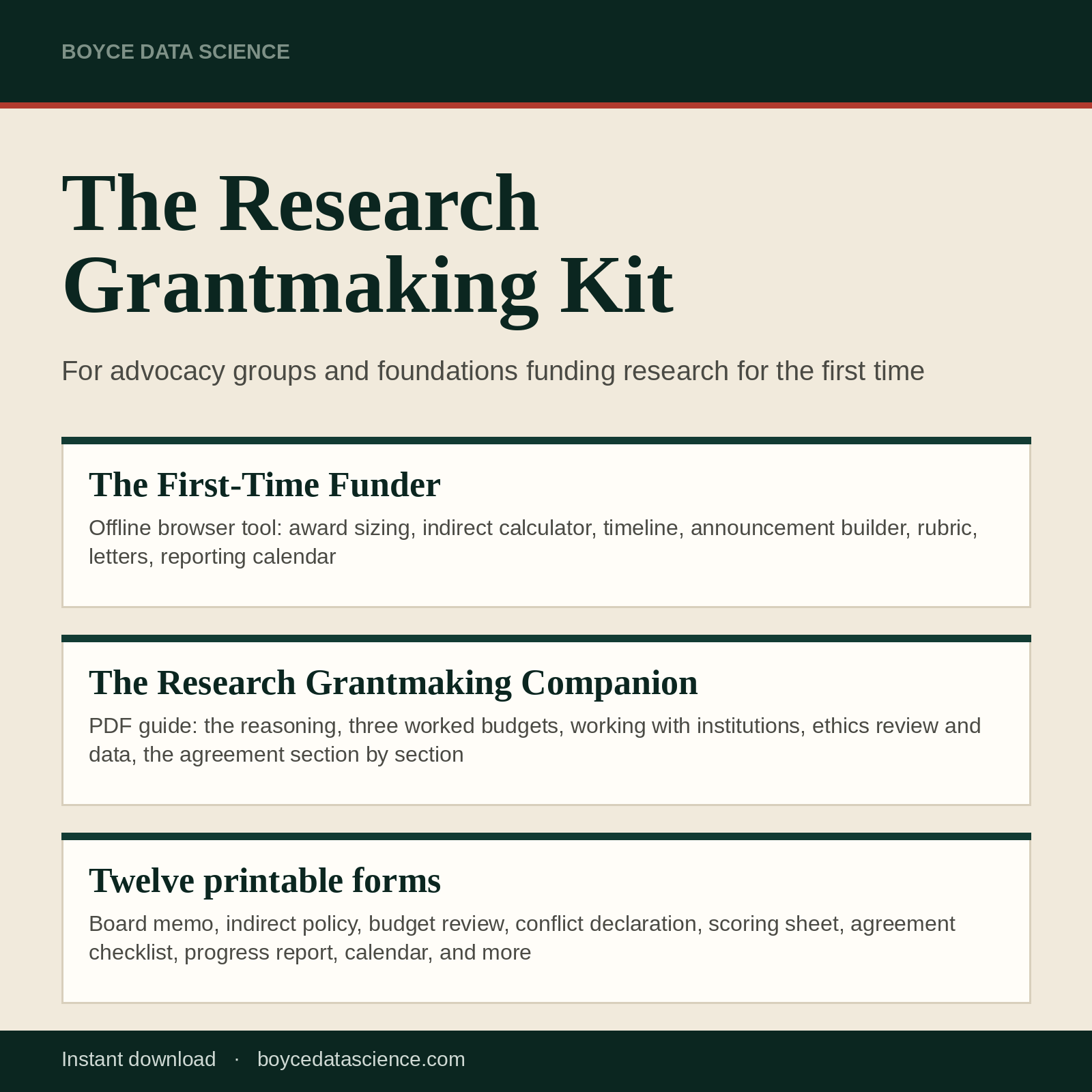
The First-Time Funder (offline tool). The same tool that is free on boycedatascience.com, as a single file that runs on your own computer with no internet connection and sends nothing anywhere. Fill in your organization once and work through the stages:
Readiness check for the board
Award sizing by kind of work, from pilot grants to registries, with a budget line builder that shows whether the award covers a realistic budget
Indirect cost explainer and calculator, with a comparison of rates at one total
Timeline builder that draws the calendar from announcement through agreement negotiation, ethics review, funded work, and final report
What a funder can and cannot decide, including why funding does not put you on the IRB-approved study team, with a clause list for the award agreement
Funding announcement builder
Review rubric with weights, reviewer instructions, scoring sheet, and conflict of interest statement
Letter generator: reviewer invitation, award, decline with feedback, revision request, report reminders, extension approval, and a public announcement
Reporting and payment calendar
Glossary and sources
The Research Grantmaking Companion (PDF, 29 pages). The reasoning behind each stage, written for an executive director or board chair with no research administration background:
The decision before the announcement: the board memo, the money, and the indirect policy
Three worked budgets: a $50,000 pilot, a two-year fellowship, and a $250,000 clinical study, with the same budget at a federal rate for comparison
Working with an academic institution: who signs, what the sponsored programs office will ask, and how long each step takes
Ethics review and data: who is on the IRB-approved study team, why the funder is not, and what to ask for instead
Running the review, with patient and family reviewers
The award agreement, section by section
After the award: reading a progress report, the check-in call, and what to do when a project is in trouble
Twelve printable forms. Board decision memo, indirect cost policy, announcement skeleton, budget review worksheet, reviewer conflict of interest declaration, scoring sheet, review meeting agenda, award agreement clause checklist, progress report template, reporting and payment calendar, check-in call script, and year-end program review. US Letter.
Who it is for. Rare disease foundations, family funds, patient advocacy organizations, and community foundations making their first research awards, and the staff and board members who will run the program.
License. One organization may use the kit for its own programs. Please do not redistribute the files.
The kit is educational and is not legal, financial, or regulatory advice. Have an attorney who works with research institutions read your award agreement before you sign it.
Tags
Full description
You raised the money. Now a scientist, a lab, or a clinical study has to receive it, and nobody on the board has done this before. How much is a reasonable award? What is an indirect rate, and why does the university want one? How long will it take before anything starts? Will you get to see the data, or be on the study team the ethics board approves? What goes in the announcement, and how do you review what comes back?
The Research Grantmaking Kit answers those questions in the order you will meet them, in plain language, with the numbers dated and the sources listed.
The First-Time Funder (offline tool). The same tool that is free on boycedatascience.com, as a single file that runs on your own computer with no internet connection and sends nothing anywhere. Fill in your organization once and work through the stages:
Readiness check for the board
Award sizing by kind of work, from pilot grants to registries, with a budget line builder that shows whether the award covers a realistic budget
Indirect cost explainer and calculator, with a comparison of rates at one total
Timeline builder that draws the calendar from announcement through agreement negotiation, ethics review, funded work, and final report
What a funder can and cannot decide, including why funding does not put you on the IRB-approved study team, with a clause list for the award agreement
Funding announcement builder
Review rubric with weights, reviewer instructions, scoring sheet, and conflict of interest statement
Letter generator: reviewer invitation, award, decline with feedback, revision request, report reminders, extension approval, and a public announcement
Reporting and payment calendar
Glossary and sources
The Research Grantmaking Companion (PDF, 29 pages). The reasoning behind each stage, written for an executive director or board chair with no research administration background:
The decision before the announcement: the board memo, the money, and the indirect policy
Three worked budgets: a $50,000 pilot, a two-year fellowship, and a $250,000 clinical study, with the same budget at a federal rate for comparison
Working with an academic institution: who signs, what the sponsored programs office will ask, and how long each step takes
Ethics review and data: who is on the IRB-approved study team, why the funder is not, and what to ask for instead
Running the review, with patient and family reviewers
The award agreement, section by section
After the award: reading a progress report, the check-in call, and what to do when a project is in trouble
Twelve printable forms. Board decision memo, indirect cost policy, announcement skeleton, budget review worksheet, reviewer conflict of interest declaration, scoring sheet, review meeting agenda, award agreement clause checklist, progress report template, reporting and payment calendar, check-in call script, and year-end program review. US Letter.
Who it is for. Rare disease foundations, family funds, patient advocacy organizations, and community foundations making their first research awards, and the staff and board members who will run the program.
License. One organization may use the kit for its own programs. Please do not redistribute the files.
The kit is educational and is not legal, financial, or regulatory advice. Have an attorney who works with research institutions read your award agreement before you sign it.